How to read a natal chart: the order I go through every chart
Updated October 12, 2026 · 8-minute read · 12 sections
Open your natal chart, find the Sun sign you already knew, and close the tab: that is how most people read a natal chart, and it throws away everything specific to you. A chart has a reading order. Follow it and ten planets, twelve houses and a tangle of aspect lines stop being noise.
I go through every chart in the same sequence: angles first, Moon second, Sun third, then the remaining planets, houses, aspects and patterns. Any natal chart calculator will hand you the numbers; what matters is what you look at first and what you ignore until later. My example throughout is a birth in New York on 15 June at 14:30 summer time (UTC−4), cast with the natal chart calculator on this site.
Check the birth data before you read a single symbol
A wrong chart read carefully is still wrong. I check three things, in this order: the time zone and summer time, whether the clock time is 12-hour or 24-hour (7:15 pm typed as 07:15 is the commonest slip; the calculator echoes 14:30 back as 2:30 PM so you can catch it), and where the birth time came from. A certificate time is solid; a remembered time rounded to the hour is a guess, and angles and houses built on it deserve suspicion.
The sky turns 360° in 24 hours, so the Midheaven moves about 1° every 4 minutes and the Ascendant moves faster. In the New York example, 14:00 gives Ascendant Libra 7°44', 14:30 gives Libra 13°41' and 15:00 gives Libra 19°38'. Forget summer time and enter the same 14:30 as UTC−5, and the Ascendant lands on Libra 25°33' while the Midheaven jumps from Cancer 15°55' to Leo 0°07', a different sign altogether.
The example chart on one page
| Point | Position | House |
|---|---|---|
| Ascendant | Libra 13°41' | 1 |
| Midheaven | Cancer 15°55' | 10 |
| Sun | Gemini 24°23' | 9 |
| Moon | Pisces 18°59' | 6 |
| Mercury | Gemini 6°09' | 8 |
| Venus | Taurus 19°05' | 8 |
| Mars | Aries 11°14' | 6 |
| Jupiter | Cancer 15°56' | 10 |
| Saturn (Rx) | Capricorn 24°00' | 4 |
| Uranus (Rx) | Capricorn 8°09' | 3 |
| Neptune (Rx) | Capricorn 13°42' | 3 |
| Pluto (Rx) | Scorpio 15°23' | 2 |
| North Node (mean) | Aquarius 9°41' | 4 |
Reading the wheel itself
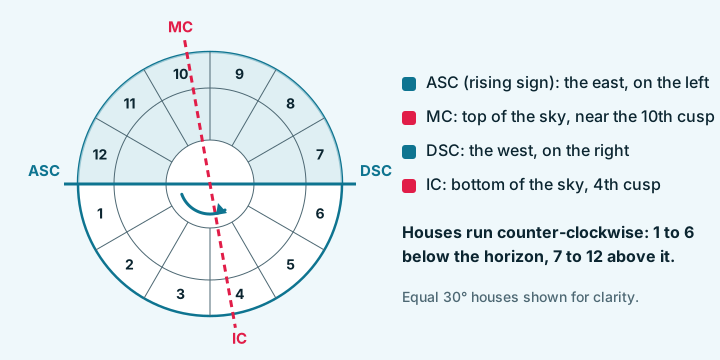
Most wheels put the Ascendant on the left, at the 9 o'clock position, and number the houses counter-clockwise from there. House 1 sits just below the left horizon, house 4 starts at the bottom, house 7 at the right and house 10 at the top. Everything above the horizontal line was above the horizon at birth. The Midheaven sits near the top but rarely exactly there; that is normal.
Step 1: the angles and the chart ruler
The Ascendant (rising sign) is how you meet new situations: manner, first reaction, the style you walk into a room with. The Midheaven is the public direction of the chart, the part of life other people see you doing. They are the frame, so they come before any planet.
Then I find the chart ruler, the traditional ruler of the rising sign. Libra rises here, so the ruler is Venus, and Venus sits in her own sign, Taurus 19°05', in the 8th house. That tells me where the chart's story starts: values, comfort and what is shared with other people. I also note the angles' contacts. In this chart the two tightest aspects of all are on the angles: Neptune square the Ascendant and Jupiter conjunct the Midheaven, both within a few hundredths of a degree.
Step 2: the Moon
I read the Moon before the Sun because it describes what you need to feel settled, and that colours everything else.Here the Moon is in Pisces 18°59' in the 6th house: a sensitive, absorbing emotional style that tends to settle through daily routines and practical work. The Moon is also the fastest body in the chart, about 13° a day, so it needs a decent birth time. On this birth date it ranges from Pisces 10°55' at midnight to Pisces 24°20' at the end of the day; the sign holds, the degree does not.
The Moon makes a close sextile to Venus, the chart ruler, with an orb of about a tenth of a degree. Easy contact between needs and ruler is worth saying out loud.
Step 3: the Sun
The Sun is the centre of purpose and effort: what you are trying to become. Gemini 24°23' in the 9th house points that effort at learning, travel, ideas and wide-angle views. The Sun makes a square to the Moon, with an orb a little over 5°. I read a Sun–Moon square as two parts of the self that want different things: a growth point, not a flaw.
Step 4: the other planets, by sign
Take the personal planets first: Mercury (thinking and speech), Venus (what you value and how you bond), Mars (drive and anger). Mercury in Gemini, Venus in Taurus and Mars in Aries all sit in their own signs, which in traditional astrology is a comfortable placement: they work openly and without much translation.
Jupiter and Saturn come next, then Uranus, Neptune and Pluto. Slow planets stay in a sign for years, so their sign describes a generation: Saturn, Uranus and Neptune all in Capricorn is shared by everyone born around then. What makes it personal is the house and the aspects, so spend your words there.
Step 5: the houses
Houses say where in life each planet acts. Learn the twelve as areas of life:
| House | Area of life |
|---|---|
| 1 | Self, body, approach to new things |
| 2 | Money you earn, possessions, values |
| 3 | Everyday communication, siblings, short trips |
| 4 | Home, family roots, private base |
| 5 | Creativity, play, romance, children |
| 6 | Daily work, routines, upkeep |
| 7 | Close partnerships, open opponents |
| 8 | Shared resources, intimacy, deep change |
| 9 | Study, belief, long journeys |
| 10 | Career, public role, reputation |
| 11 | Friends, groups, hopes |
| 12 | Solitude, rest, the unconscious |
Mind the house system. The same chart puts Mercury in the 8th house with Placidus and in the 9th with Whole Sign. I explain why in Placidus vs Whole Sign houses.
Step 6: aspects, tightest first
An aspect is an angle between two bodies along the zodiac: conjunction (0°), sextile (60°), square (90°), trine (120°) and opposition (180°). The orb is how far the angle is from exact. Sort by orb and read from the top. My rule: under 1° is the loudest voice in the chart, 1–3° is clearly present, beyond about 5° is background. The calculator's defaults are 8° for conjunction, opposition and trine, 7° for square and 6° for sextile; I use those as outer limits, not as a promise that every aspect inside them matters equally. You can change each orb from 0° to 12° in the calculator, and the Ascendant and Midheaven are included in the list.
| Aspect | Orb |
|---|---|
| Neptune square Ascendant | 0.01° |
| Jupiter conjunct Midheaven | 0.03° |
| Moon sextile Venus | 0.11° |
| Pluto trine Midheaven | 0.53° |
| Sun square Moon | 5.40° |
Aspects to the Ascendant and Midheaven outweigh aspects between two ordinary planets.
Step 7: patterns and balance
Count the ten planets (Sun to Pluto) by element and by modality. The example has earth 4, water 3, air 2, fire 1, and cardinal 5, mutable 3, fixed 2. Mars is the only fire planet, so it carries the whole element: I would treat it as the chart's spark. The calculator draws these counts as bars under the tables.
Look for a stellium, three or more planets packed within about 8–10° in one sign or house. Here Uranus, Neptune and Saturn spread over roughly 16° of Capricorn; that is a loose cluster, not a stellium, and I would not build a reading on it.
Step 8: the North Node, last
The nodes mark where the Moon's path crosses the Sun's. I treat the North Node as a direction of growth and the South Node opposite it as the familiar default. Here the mean North Node is Aquarius 9°41' and the true node about 1.5° away, with the South Node in Leo. Programs default to different node types, so a one- or two-degree gap between sites is a setting, not a mistake. The node adds a theme; it does not overturn the picture.
Putting the pieces into a paragraph
When I finish I write one paragraph. For the example: Libra rising, its ruler Venus at home in Taurus, a Pisces Moon tuned to daily routines, a Gemini Sun looking outward from the 9th house, and the two tightest contacts on the Ascendant and Midheaven. If you cannot summarise your own chart that way, go back to step 1.
Once the natal chart reads clearly, the next question is timing: how to read transits against your natal planets.
Common questions
What do I read first in a natal chart?
The angles: the Ascendant and Midheaven, then the chart ruler. After that I read the Moon, then the Sun, and only then the other planets, houses and aspects.
Does the order change if I do not know my birth time?
Yes. Without a reliable time, skip the angles and houses and read only planet signs and the aspects between planets. The Moon sign holds unless the Moon changes sign during that day.
How wide an orb should I allow for natal aspects?
Common limits are 8° for conjunction, opposition and trine, 7° for square and 6° for sextile. I weigh an aspect under 1° far above one at 5° or more.
Why does my chart look different on another website?
Usually a different house system, a mean versus true node, or a different time zone offset. Planet signs and degrees should agree to within a minute or two of arc.
Is one planet in a sign enough to define me?
No. A planet in a sign is one ingredient. House, aspects and the chart as a whole shape how it is expressed, which is why the reading order matters.