Placidus vs Whole Sign houses: why planets change house
Updated October 12, 2026 · 7-minute read · 6 sections
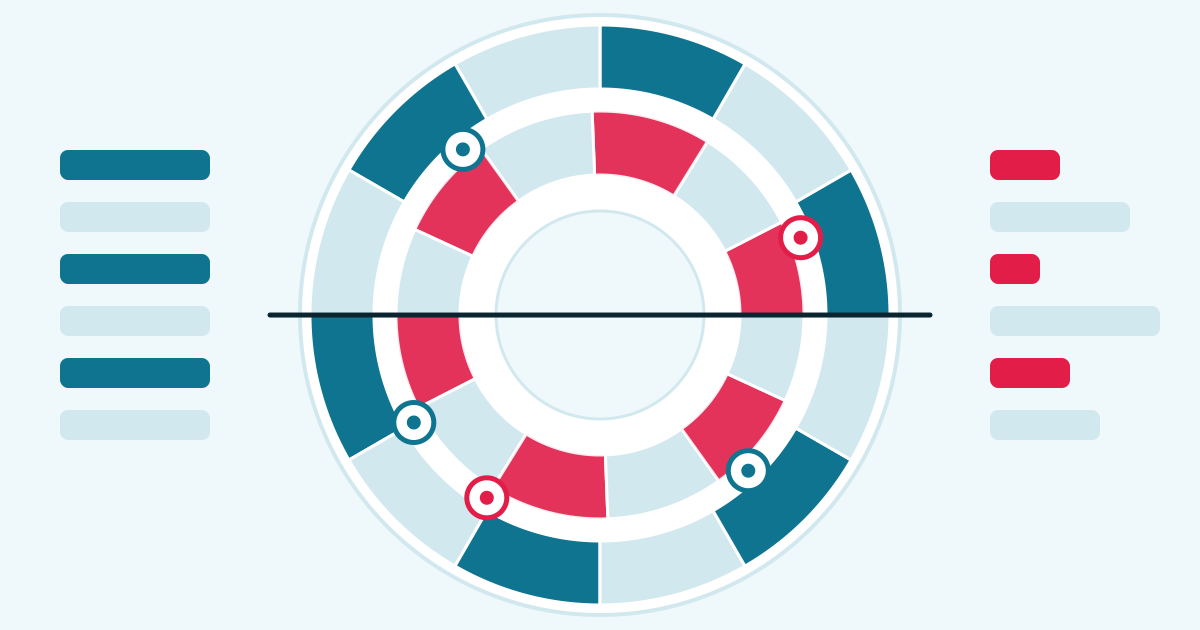
Two chart sites, the same birth data, and your Mars is in the 6th house on one and the 7th on the other. Neither site is broken. They disagree because "house" has no single definition: Placidus and Whole Sign cut the same sky into twelve slices in different ways, and a planet near a boundary can fall on either side.
I cast charts in both systems and I have a firm view on how to choose between them, which I give at the end. First, what the choice changes, because it is less than most people fear. Signs, degrees, retrograde marks and aspects between planets are identical in every house system. Only the house of each planet changes, together with the house cusps and anything you read from them. Every number here comes from a birth in New York on 15 June at 14:30 summer time, cast with the natal chart calculator.
What a house system decides
The Ascendant and Midheaven are astronomical points: the degree rising on the eastern horizon and the degree crossing the meridian. Houses are a layer on top. A house system decides where cusps 2, 3, 5, 6 and the other intermediate boundaries fall, and whether each house is 30° wide or something else. With the Ascendant at Libra 13°41', the 1st house cusp is always Libra 13°41' in Placidus, Equal and Porphyry, but in Whole Sign the 1st house simply starts at Libra 0°00'.
Because the Earth turns on a tilted axis, signs rise at different speeds. At New York's latitude Libra takes about 2½ hours to rise, while Aries and Pisces are over in about 1¼ hours each. Time-based systems such as Placidus let houses stretch and shrink to follow that; sign-based systems ignore it.
The four systems in the calculator
| System | How the cusps are found | House size | Works near the poles? |
|---|---|---|---|
| Placidus | Divides the time a degree takes to travel between angles into thirds | Unequal, follows latitude | No, fails beyond about 66.5° |
| Whole Sign | The sign of the Ascendant is house 1, the next sign house 2, and so on | Always 30° | Yes |
| Equal | Starts at the exact Ascendant degree, adds 30° each time | Always 30° | Yes |
| Porphyry | Splits each of the four quadrants between the angles into three equal parts | Unequal, simple geometry | Yes |
Placidus is the default in most software, which is why most printed charts you see use it. Whole Sign is the oldest of the four in the Western tradition, and it is what Hellenistic astrologers used. Equal houses are the simplest quick fix when you do not have a Midheaven you trust. Porphyry is the one I use as a fallback, for reasons you will see below. In the calculator the four systems are buttons above the wheel; the planet table and the cusp table change as soon as you press one.
One chart, four house systems
Here are the New York cusps. Placidus and Porphyry both anchor the 4th cusp on the Imum Coeli (Capricorn 15°55'), and differ only in the intermediate houses; Equal and Whole Sign do not put the 4th cusp there at all.
| House | Placidus | Porphyry | Equal | Whole Sign |
|---|---|---|---|---|
| 1 | Libra 13°41' | Libra 13°41' | Libra 13°41' | Libra 0°00' |
| 2 | Scorpio 10°46' | Scorpio 14°26' | Scorpio 13°41' | Scorpio 0°00' |
| 3 | Sagittarius 11°55' | Sagittarius 15°10' | Sagittarius 13°41' | Sagittarius 0°00' |
| 4 | Capricorn 15°55' | Capricorn 15°55' | Capricorn 13°41' | Capricorn 0°00' |
| 5 | Aquarius 19°18' | Aquarius 15°10' | Aquarius 13°41' | Aquarius 0°00' |
| 6 | Pisces 18°54' | Pisces 14°26' | Pisces 13°41' | Pisces 0°00' |
Houses 7 to 12 mirror these exactly, six signs further round. Now the planets that move when you switch:
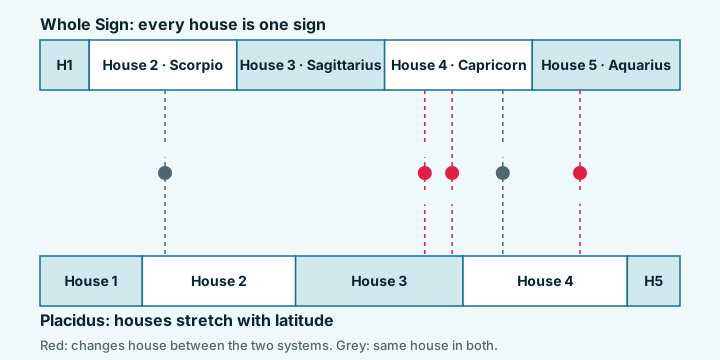
| Planet | Position | Placidus | Whole Sign |
|---|---|---|---|
| Mercury | Gemini 6°09' | 8 | 9 |
| Mars | Aries 11°14' | 6 | 7 |
| Uranus (Rx) | Capricorn 8°09' | 3 | 4 |
| Neptune (Rx) | Capricorn 13°42' | 3 | 4 |
| North Node (mean) | Aquarius 9°41' | 4 | 5 |
| Sun, Moon, Venus, Jupiter, Saturn, Pluto | various | same house in both | |
Four of the ten planets change house, plus the node. The pattern is easy to spot once you see the cusp table: Placidus puts the 4th cusp at Capricorn 15°55', so everything in Capricorn up to that degree is still in the 3rd house, while Whole Sign has the 4th house starting at Capricorn 0°. Mars at Aries 11°14' is in the 6th in Placidus because the 7th cusp is Aries 13°41', about 2½° further on.
What the difference means in a reading
A planet moving from the 6th to the 7th is not a typo; it changes the question you ask. Mars in the 6th is energy poured into daily work and upkeep. Mars in the 7th is energy that shows up in partnerships, through the other person or through friction with them. The planet is the same Mars. Which area of life it speaks through is what the system decided.
The planets that matter most are the ones close to a cusp. A planet within a couple of degrees of a boundary is a judgement call, and many readers treat one just before a cusp as acting in the next house too. A planet in the middle of a house, like Venus here at Taurus 19°05' in the 8th house, gets the same answer from Placidus, Porphyry, Equal and Whole Sign, and I trust those placements most.
Placidus fails in the far north
Placidus divides the time a degree of the zodiac takes to rise and set. Above about 66.5° latitude some degrees never rise or never set during part of the year, and the arithmetic has no answer. The Swiss Ephemeris documentation notes that Placidus and Koch cannot be calculated beyond the polar circles, and its software falls back to Porphyry there (Swiss Ephemeris). Cafe Astrology's own chart form warns about the same limit (Cafe Astrology).
A Tromsø birth at 12:00 on 21 December, latitude 69.6492°, shows it: Placidus is undefined, so the calculator switches to Porphyry and says so. The angles are still fine at Pisces 5°26' (Ascendant) and Capricorn 3°46' (Midheaven). If you were born that far north and want a system that never needs a fallback, Whole Sign is the clean answer.
How to choose
I give beginners the same procedure every time:
- Check the birth time first. Placidus, Porphyry and Equal cusps move with minutes. If the time is a guess, use Whole Sign, where the houses do not shift until the rising sign itself changes.
- Cast the chart in two systems and list the planets that change house. Usually it is two to four.
- Read the unchanged planets first. They give you the stable part of the chart.
- Pick one system and keep it across all your charts and every comparison you make. Switching mid-reading is how you end up with a contradiction that is really a settings difference.
My own habit: Placidus when the time is solid and the birthplace is below the polar circle, Whole Sign for everything else. If someone shows me a reading from another site that disagrees with mine on a house, the first thing I ask is which system it used, then whether it used the mean or the true node. Those two settings explain almost every mismatch.
With the house system settled, how to read a natal chart walks through the order I use for the whole chart, and transits to your natal chart shows what moving planets do to those houses.
Common questions
Which house system is the most accurate?
None is more accurate; each is a different definition of a house. Placidus follows the time signs take to rise, Whole Sign uses whole signs. Choose one and use it consistently.
Why did my planet change house when I switched systems?
The planet sits near a boundary. Placidus cusps fall at a particular degree while Whole Sign houses begin at 0° of a sign, so planets in the early or late degrees of a sign can land in a neighbouring house.
Does the house system change my rising sign?
No. The Ascendant and Midheaven are astronomical points and are the same in every system. In Whole Sign the whole rising sign becomes the 1st house.
Why does Placidus not work in northern Norway or Alaska?
Beyond about 66.5° latitude some zodiac degrees never rise or set at certain times of year, so the time-based arithmetic has no solution. The calculator uses Porphyry and tells you.
What should I use if I am not sure of my birth time?
Whole Sign. Its houses only change when the rising sign changes, so it tolerates small time errors better than Placidus, Porphyry or Equal houses.