Transits to your natal chart: what the sky is doing now
Updated October 12, 2026 · 6-minute read · 6 sections
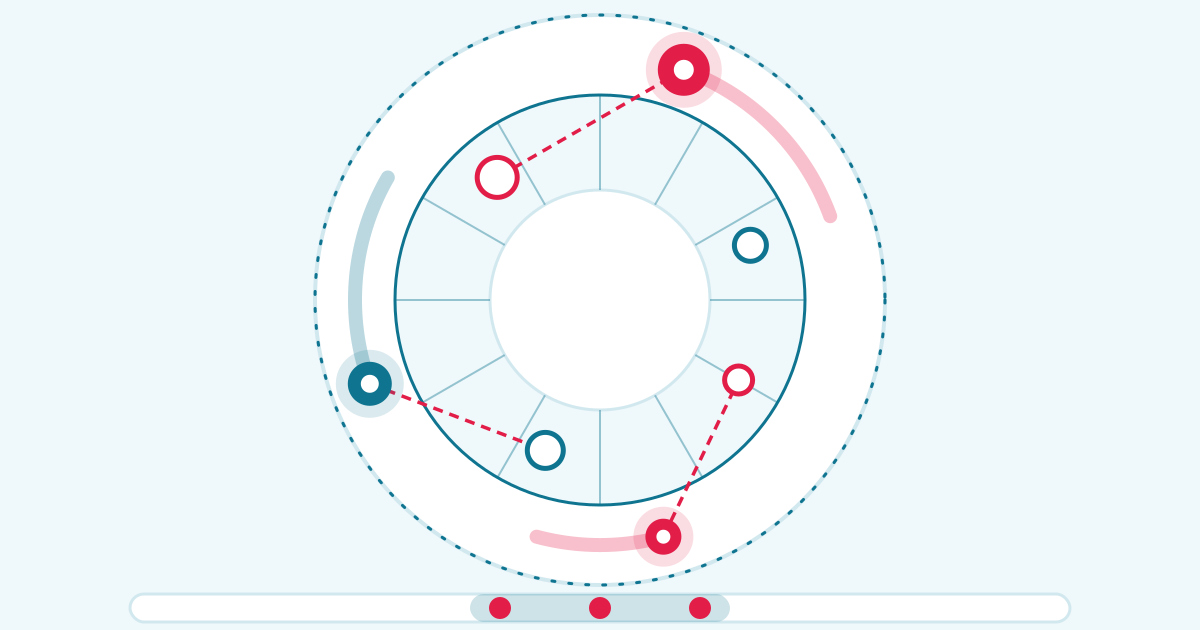
Fast planets set the weather of a day; slow planets set the season you are living in. That one sentence is most of what you need to read transits to your natal chart, and the rest is knowing which contacts deserve attention and how long each one lasts.
Your natal chart is a fixed picture of the sky at your birth. A transit is where a planet is right now, compared with a point in that picture: transiting Saturn crossing your natal Sun, transiting Mars touching your Ascendant. The same five aspects apply (conjunction, sextile, square, trine, opposition), but the orbs are tighter. I work with about 2° for transits, against 6–8° in the natal chart, and the natal chart calculator on this site uses 2° by default for its transit ring (you can choose 1° or 3°). The examples below use the natal chart cast for New York on 15 June at 14:30 summer time.
The speed of the sky decides everything
The slower a transiting planet moves, the longer a contact lasts and the heavier the theme. A table helps, because the differences are enormous. The last column assumes a direct pass through a 2° orb on each side, a 4° window in all:
| Transiting body | Average pace | Time in the 4° window | What it usually times |
|---|---|---|---|
| Moon | about 13° a day | about 7 hours | The mood of an afternoon |
| Sun | about 1° a day | about 4 days | A focus for a few days |
| Mercury, Venus | about 1° a day, with big swings | a few days to weeks | Conversations, contacts, plans |
| Mars | about 0.5° a day | about a week | Bursts of drive and friction |
| Jupiter | about 30° a year | about 7 weeks | Openings, growth, expansion |
| Saturn | about 12° a year | about 4 months | Commitments, structure, pressure |
| Uranus | about 4° a year | about 11 months | Disruption of routine, new angles |
| Neptune | about 2° a year | about 1¾ years | Blurred certainties, idealism |
| Pluto | about 1.5° a year, uneven | about 3 years | Slow, deep restructuring |
The Moon crosses every point of your chart each month, so a Moon transit alone never means much. Mark it as timing, not as a theme. A Saturn transit to your natal Sun is a different animal: it sits in your life for months and sometimes comes back twice.
Which transits to read first
With the whole sky moving, the sensible filter is to start from the targets. In order of priority, this is how I filter:
- Slow planets (Jupiter to Pluto) to the Sun, Moon, Ascendant, Midheaven and chart ruler. These are the contacts people remember.
- Tight orbs only. Inside 1° the contact is at full strength; between 1° and 2° it is building or fading.
- Applying before separating. A contact still approaching exactness is the one still developing.
- Fast planets last, as triggers. Mars or the Sun crossing a degree a slow planet is already working on tends to mark the specific day it surfaces.
Contacts to the Ascendant and Midheaven need a trustworthy birth time. The Midheaven moves about 1° every 4 minutes, so a time that is 10 minutes out shifts it by around 2½°, more than the whole transit orb. If the time is a guess, read transits to planets only. How the angles and houses are fixed is in Placidus vs Whole Sign houses.
A worked contact: Mars to the natal Sun
The example chart has the Sun at Gemini 24°23'. Suppose transiting Mars (direct) stands at Gemini 22°30' on the day you check. Orb = 24°23' − 22°30' = 1°53', inside the 2° limit, and applying because Mars is moving forward toward the Sun's degree. At about half a degree a day it reaches exactness in roughly four days and leaves the orb a few days after. That is a short window of higher energy, drive and perhaps irritation, worth planning around, not worrying about.
Retrograde loops make three passes
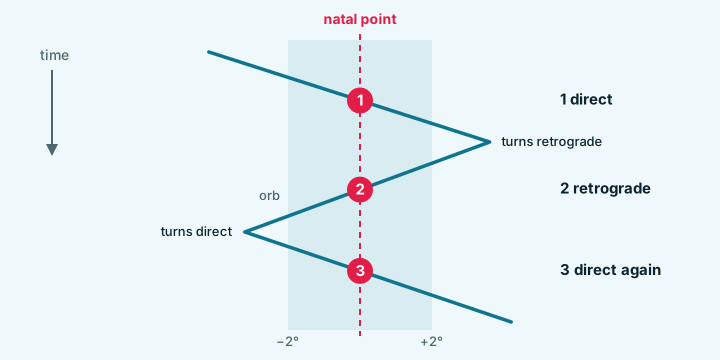
Seen from Earth, every planet from Mercury outward periodically appears to move backward. Mercury does it about three times a year, for roughly three weeks each time; Jupiter to Pluto spend four to six months of every year retrograde. The Sun and Moon never do. The result for transits is that a planet can cross the same degree three times: direct, then retrograde, then direct again.
Here is a hypothetical Saturn making that triple pass over the natal Sun in the example chart. The station degrees are illustrative; the pattern is real.
| Pass | Motion | Meaning in practice |
|---|---|---|
| 1st | Direct, moving forward | The theme appears; first look at the issue |
| 2nd | Retrograde, moving back | The review: what you did in the first pass gets tested |
| 3rd | Direct again | The closing: you act on what the review taught |
When you list a transit, write down the whole date range from the first entry into the orb to the last exit, not just the first exact date. Otherwise you will count one three-pass episode as three unrelated events.
A cycle to practise on: Saturn
Saturn circles the zodiac in about 29½ years, so a Saturn return happens roughly every 29 to 30 years. It is the cleanest cycle to learn because it divides into four phases. Take the natal Saturn of the example chart, Capricorn 24°00' (retrograde at birth, which does not change the maths):
| Phase | Angle from natal Saturn | Transiting Saturn at | Roughly at age |
|---|---|---|---|
| First square | 90° | Aries 24°00' | 7 |
| Opposition | 180° | Cancer 24°00' | 14–15 |
| Second square | 270° | Libra 24°00' | 22 |
| Return | 360° | Capricorn 24°00' | 29–30 |
Saturn's cycle is a recurring audit of commitments: what structure is carrying weight, what is only habit. I read Saturn contacts as pressure that rewards effort, not as punishment, and I treat the return as a good moment to ask what you are building, not as a time to brace for trouble.
Using the transit ring
- Fix the natal chart first. Check the time zone offset and the birth time; transits to a wrong chart are wrong.
- Open the transits panel. The calculator draws the transiting planets on an outer ring around your natal wheel. The default is today's sky at the current moment; pick another date and it is taken at 12:00 UT. The list covers the Sun to Pluto against your natal planets, the node, the Ascendant and the Midheaven.
- Read the list of contacts sorted by orb. Begin at the top, with anything under 1°. To see whether a contact is applying or separating, move the date a day or two forward: if the orb shrinks, it is still approaching.
- Step the date forward and back until a contact enters and leaves the 2° orb to find its window.
- Write the contact down with its dates and look back later at what actually happened. Astrology is a language for reflection, and this log is how you learn whether a given contact means anything for you.
If you are new to the chart itself, start with how to read a natal chart and come back here when the natal picture is familiar.
Common questions
What is a transit in astrology?
A transit is the current position of a planet compared with a point in your natal chart. When the transiting planet makes an aspect to a natal planet or angle, that contact is read as symbolic timing.
What orb should I use for transits?
About 2° is a good working limit. Inside 1° the contact is at full strength; between 1° and 2° it is building or fading.
Which transits last longest?
Those from the slow planets. Saturn takes about 4 months to cross a 4° window directly, Uranus about 11 months, Neptune close to 2 years and Pluto about 3 years, longer when retrogrades add extra passes.
How often does a Saturn return happen?
About every 29 to 30 years, when transiting Saturn comes back to the degree it held at birth.
Do I need my birth time to read transits?
For transits to planets, no, apart from the Moon. For transits to the Ascendant, Midheaven and houses, yes, because those points move about 1° every 4 minutes or faster.