Natal Chart Calculator: Planets, Houses and Rising Sign to the Minute
Half an hour of birth time moves your rising sign by about six degrees, so a natal chart calculator has to get the clock right before it can get the sky right. Enter your date, time and place: the offset for that exact moment, summer time included, is filled in for you, and the whole chart is computed on your device.
Natal Chart Calculator
Your natal chart
Trine, sextile Square, opposition Transits (outer ring)
Planets
| Glyph | Planet | Position | House | Motion |
|---|
House cusps
| House | Cusp | House | Cusp |
|---|
Without a birth time
Rising sign through the day
Aspects
Orbs (how far from exact an aspect still counts)
| Planet | Aspect | Planet | Orb |
|---|
Transits to this chart
| Transiting planet | Aspect | Natal point | Orb |
|---|
Element and modality balance
What the placements mean
What a natal chart is, and the three things it needs
A natal chart is a map of the sky drawn for one moment and one place: where the Sun, Moon and planets stood along the zodiac, which degree was rising on the eastern horizon, and which degree crossed the meridian. Shift the moment by a few minutes and the planets barely move, but the horizon and the houses do. That is why I treat the input as seriously as the reading.
- Date of birth as written on the local calendar where you were born.
- Time of birth from the most official record you have. A birth certificate or hospital record beats family memory; "around lunchtime" is a range, not a time. Enter it on the 24-hour clock: 7:15 pm is 19:15, and typing 07:15 builds a chart twelve hours off. The calculator echoes what you type as a 12-hour time (14:30 appears as 2:30 PM), so that slip shows up at once.
- Place of birth, which gives latitude, longitude and the time zone. The offset that matters is the one the clocks showed on that day, summer time included, not the zone the city uses today.
Getting a correct chart from the natal chart calculator
- Start typing the city of birth. Its coordinates and its time zone fill in, and the calculator works out the UTC offset for that exact date and hour from your browser's own time-zone data, so summer time is applied when it was in force. More than 600 cities are listed with their time zones, and the search ignores accents and understands local names such as München or Sevilla. A place that is not listed can be entered by latitude, longitude and UTC offset.
- Look at the offset it shows before anything else. I always check the time zone first; it is the most common reason a chart comes out wrong. If you were born before 1970 or in a place whose clocks changed often, compare it with a record you trust and override it by hand if needed. The offset is labelled standard, summer, double summer or local mean time. If your clock time did not exist that day because clocks jumped forward, you get a warning; if it happened twice because clocks went back, a box lets you say which of the two hours you were born in.
- Enter the time. If you do not know it, tick the unknown-time box instead of guessing noon: the chart then leaves out the parts a missing time would break.
- Pick a house system if you have a preference. Placidus is the default; Whole Sign, Equal and Porphyry are one click away above the wheel, and the tables update at once.
- Read the big three at the top, then the planet table, the houses, the aspects and the wheel. Open the transits panel when you want to see today's sky, or any date, laid over your chart.
Everything is computed on your own device. Nothing you type is sent anywhere, and the calculator keeps only your last input in this browser, with a button to clear it.
Reading the result in the order I use
Beginners start with the Sun sign and stop there. I read from the frame inwards:
- The big three. Sun, Moon and rising sign (Ascendant, ASC). I read the Moon before the Sun: it shows what you need to feel settled, and it is the placement people recognise in themselves fastest.
- Planets in signs. Each line gives sign, degree and minute, for example Venus Taurus 19°05', plus an Rx mark when the planet was retrograde.
- Houses. The twelve areas of life the planets fall into. A planet in the 10th is on show; the same planet in the 4th works in private.
- Aspects. The angles between planets. The default orbs are conjunction 8°, opposition 8°, trine 8°, square 7° and sextile 6°, and you can set each one anywhere from 0° to 12°. The Ascendant and Midheaven take part in the aspects, and the list can be switched to a triangle grid. Read the exact ones first: an aspect within a degree speaks louder than one at the edge of its orb.
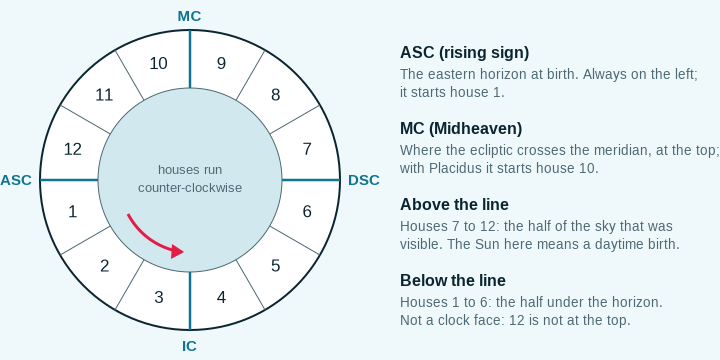
- The wheel. It is not a clock face. The ASC sits on the left, the Midheaven (MC) near the top, and the houses run counter-clockwise from the ASC.
Below the tables, bars count your planets by element and modality, and a short "what the placements mean" section gives a plain line for each planet by sign and house, plus one for the rising sign. When you are done, you can save the wheel as a PNG or SVG, print the page or copy a text summary of the chart.
The full walk-through, with this order applied to one real chart, is in how to read a natal chart.
Why the minute and the time zone matter
The sky turns 360° in 24 hours, so the Midheaven moves about 1° every 4 minutes, and the Ascendant moves on average just as fast. Here is one birth in New York on 15 June, summer time in force (UTC−4), entered at three times half an hour apart:
| Local time | Ascendant | Midheaven |
|---|---|---|
| 14:00 | Libra 7°44' | Cancer 8°57' |
| 14:30 | Libra 13°41' | Cancer 15°55' |
| 15:00 | Libra 19°38' | Cancer 22°58' |
Half an hour moved the ASC by about 6° (193.695° − 187.738° = 5.96°) and the MC by about 7° (105.922° − 98.961° = 6.96°). Every house cusp moves with them, so a planet near a cusp can change house on a rounded birth time.
Now the classic mistake: the same 14:30 entered with the standard offset UTC−5, forgetting summer time. The chart is computed for an hour later in real time. The ASC jumps to Libra 25°33' (+11.87°) and the MC to Leo 0°07' (+14.21°), so the Midheaven changes sign. Wartime Britain is a harder case: London ran on double summer time, UTC+2, in the summer of the war years, so a noon birth there is two hours away from Greenwich time. The calculator takes these offsets from the browser's copy of the IANA time-zone database, but the IANA maintainers themselves say most entries before 1970 come from unreliable sources (IANA tz theory). For an older birth, check the offset it shows.
Not every rising sign lasts two hours. Signs rise quickly or slowly depending on how steeply they meet the horizon, and the spread grows with latitude:
| Rising sign | Delhi 28.7° N | New York 40.7° N | London 51.5° N |
|---|---|---|---|
| Aries, Pisces | 1:26 | 1:11 | 0:52 |
| Taurus, Aquarius | 1:39 | 1:26 | 1:09 |
| Gemini, Capricorn | 2:00 | 1:54 | 1:46 |
| Cancer, Sagittarius | 2:17 | 2:22 | 2:31 |
| Leo, Scorpio | 2:20 | 2:33 | 2:50 |
| Virgo, Libra | 2:17 | 2:31 | 2:50 |
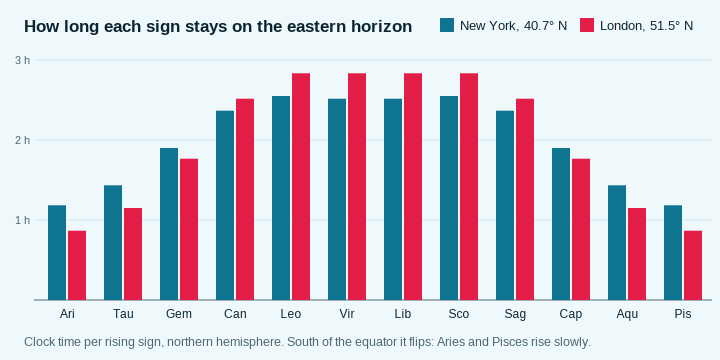
So if your rising sign is Aries or Pisces and you were born far north, a 15-minute error matters far more than it would for a Libra rising in Delhi.
A sample chart, read with numbers
The New York birth at 14:30 summer time (UTC−4, 40.7128° N, 74.0060° W) is the chart I use for checking. Its houses here are Placidus, with Whole Sign alongside to show where the two systems disagree.
| Point | Position | Placidus house | Whole Sign house |
|---|---|---|---|
| Sun | Gemini 24°23' | 9 | 9 |
| Moon | Pisces 18°59' | 6 | 6 |
| Mercury | Gemini 6°09' | 8 | 9 |
| Venus | Taurus 19°05' | 8 | 8 |
| Mars | Aries 11°14' | 6 | 7 |
| Jupiter | Cancer 15°56' | 10 | 10 |
| Saturn | Capricorn 24°00' Rx | 4 | 4 |
| Uranus | Capricorn 8°09' Rx | 3 | 4 |
| Neptune | Capricorn 13°42' Rx | 3 | 4 |
| Pluto | Scorpio 15°23' Rx | 2 | 2 |
| North Node (mean) | Aquarius 9°41' | 4 | 5 |
The tightest aspects tell me where to start. Neptune squares the Ascendant with an orb under 1' (283.710° against 193.695°, a separation of 90.015°). Jupiter sits on the Midheaven, 0°01' apart. The Moon sextiles Venus at 0°06'. Mars opposes the Ascendant at 2°27'. The Sun–Moon square is real but loose at 5°23' (84.388° and 348.990° are 95.40° apart), inside the 7° orb and well behind the exact contacts in weight.
House systems in brief
The planets' signs do not depend on the house system; only the house boundaries do. The four on offer cover what most readers use:
- Placidus divides the time each degree takes to climb from horizon to meridian. It is the default in most software, and the one most published charts use.
- Whole Sign makes the rising sign the whole 1st house, the next sign the 2nd, and so on. It is the oldest system and the easiest to read by eye.
- Equal starts at the exact ASC degree and steps 30° per house.
- Porphyry splits each quadrant between the angles into three equal parts.
In the sample chart, Mercury moves from the 8th to the 9th house, Mars from the 6th to the 7th, Uranus and Neptune from the 3rd to the 4th and the node from the 4th to the 5th when you switch from Placidus to Whole Sign. Neither answer is wrong; they are two conventions. Placidus and Koch cannot be computed beyond the polar circles, about 66.5° north or south (Swiss Ephemeris documentation), so for a birth in Tromsø or northern Alaska the calculator falls back to Porphyry and says so on screen. My advice: try both, then stay with one. Why the switch moves planets, and how to choose, is in Placidus vs Whole Sign houses.
No birth time: what still holds
| Part of the chart | Reliable? |
|---|---|
| Sun, Mercury, Venus, Mars and the outer planets by sign | Yes, unless a planet changed sign that day |
| Aspects between planets | Yes; the calculator leaves the Moon out of the list, because its position depends on the time |
| Moon sign | Often; it moves about 13° a day and can change sign |
| Rising sign, Midheaven, houses | No; the rising sign changes roughly every one to three hours |
A noon chart keeps the Moon within about 6–7° of its true place (The Astrology Podcast on charts without a birth time), but that is not always enough. In London on 10 January in the first control chart below, the Moon stood at Leo 27°14' at midnight and Virgo 11°27' at 23:59, so the date alone cannot settle the Moon sign. The unknown-time view shows exactly this range with the time the Moon changes sign (here about 04:40 local time), computes the other planets for local noon, hides the angles and houses instead of drawing fake ones, and lists which sign was rising during which hours at your birthplace, so you can compare the windows with what you know about yourself. If the Moon changes sign that day, it is also left out of the element count.
Transits on the same wheel
A transit is where a planet is now, measured against where it was in your natal chart. The calculator can draw today's sky, or any date you pick, on an outer ring and list each aspect from a transiting planet (Sun to Pluto) to your natal planets, the node, the Ascendant and the Midheaven, with its orb. Today uses the current moment; any other date is taken at 12:00 UT. Transit orbs are tighter than natal ones, 2° by default and 1° or 3° if you prefer, because a moving planet only holds an aspect for a while: the Moon passes in hours, the Sun in a few days, Saturn for weeks or months, often three times because of retrograde loops. Contacts to the angles, the Sun and the Moon come first. More in transits to your natal chart.
The astronomy behind the result
What happens after you press the button:
RAMC = sidereal time at Greenwich + east longitude (+ nutation)
MC = atan2(sin RAMC, cos RAMC · cos ε)
ASC = atan2(cos RAMC, −(sin ε · tan φ + cos ε · sin RAMC))
Here ε is the obliquity of the ecliptic and φ the birth latitude. Placidus cusps are found by iterating the semi-arc of each cusp degree until it stops moving, which is why they fail beyond the polar circles where some degrees never rise or set. The Sun, the Moon and the mean lunar node come from standard analytic series. Mercury to Pluto use the orbital elements published by NASA JPL for 1800 to 2050 (JPL approximate positions of the planets), with light time, precession to the date of birth, nutation and aberration applied, giving apparent tropical longitudes. Births outside that range are not supported, and the tool tells you so.
The results are checked against Swiss Ephemeris, the engine behind most serious astrology software (Swiss Ephemeris). Across eight control charts the largest differences were under 1' for the Sun, Mercury, Venus and the node, under 2' for the Moon, Mars, Uranus, Neptune and Pluto, under 9' for Jupiter and Saturn, and a small fraction of an arcminute for the angles and house cusps, which is well inside any orb anyone reads. Minutes are truncated, never rounded up, so a planet at 29.9995° of Aries shows as Aries 29°59', not a non-existent 30°00'. Five of the control charts, the same ones the test page of this calculator checks:
| Input | UTC offset | Expected result |
|---|---|---|
| London, 1985-01-10 08:00 | +0 | ASC Capricorn 17°05', MC Scorpio 22°04', Sun Capricorn 20°01', Moon Virgo 1°58' |
| New York, 1990-06-15 14:30 | −4 | ASC Libra 13°41', MC Cancer 15°55', Placidus 2nd cusp Scorpio 10°46', Venus Taurus 19°05' |
| Delhi, 2010-03-21 00:30 | +5:30 | Sun Aries 0°03', Moon Taurus 27°01', ASC Sagittarius 17°58' |
| London, 1941-06-01 12:00 | +2 | ASC Leo 24°27', Moon Leo 21°56' |
| Tromsø, 1980-12-21 12:00 | +1 | Placidus not available, Porphyry used with a note; ASC Pisces 5°26', MC Capricorn 3°46' |
The Delhi case is there on purpose: a birth at half past midnight must stay at 00:30, not drift to noon, and the offset of five and a half hours must survive. London in wartime checks double summer time, and Tromsø checks the polar fallback. If two programs disagree on your chart, compare their settings before their skill: house system, mean or true node (they differ by up to a degree or two because the Sun perturbs the Moon's orbit) and, above all, the UTC offset.
Guides
 How to read a natal chart: the order I go through every chartThe order I read every natal chart: angles, Moon, Sun, planets, houses, aspects, patterns and the node, with one worked example.8-minute read
 Placidus vs Whole Sign houses: why planets change houseSame birth data, different houses. A worked New York chart shows which planets move between Placidus and Whole Sign, and how to choose.7-minute read
 Transits to your natal chart: what the sky is doing nowWhich transits matter, how long each lasts, and how to use the transit ring on your natal wheel, with a worked Mars and Saturn example.6-minute read
Common questions
Why does my chart look different on another website?
Compare the settings first: the UTC offset used for your birth, the house system (Placidus and Whole Sign put planets in different houses) and mean versus true node. With the same offset and the same system, accurate programs agree within a few arcminutes.
Which house system should I use?
Placidus is the common default and a good start; Whole Sign is older and simpler to read. Try both on your chart, then stay with one so your readings are consistent.
What is the difference between the mean and true node?
The mean node is the average position of the Moon's orbital crossing; the true node includes the wobble caused by the Sun's pull on the Moon. They can differ by a degree or two, and either is a valid choice. The calculator uses the mean node.
Can I trust my rising sign?
If your birth time comes from a certificate or hospital record and the UTC offset is right, yes. If the time is rounded or remembered, check how close the Ascendant is to a sign boundary: within a few degrees, a 15-minute error can change it.
Can I get a natal chart without a birth time?
Yes. Planet signs and planet-to-planet aspects still hold, and the calculator shows the Moon's range for the day and which signs rise in which hours. Leave the rising sign, Midheaven and houses aside until you find the time.
Is my birth data stored or sent anywhere?
No. The natal chart calculator runs entirely in your browser; only your last input is remembered on this device, and you can clear it.
Updated